Alasdair Turner
- October 6, 2011
- 41 years
- stomach cancer
About Alasdair Turner
Alasdair Turner, 41, British scientist, stomach cancer.
Explore other notable deaths in 2011 or deaths in October 2011.
The Deaths Archive presents
How well do you know Alasdair Turner?
Explore their life. Test your knowledge. Beat the challenge.
10 questions · One legacy · How much do you really know?
Challenge your friends
Play together in real-time.
Advertisement

60 Seconds Life Story



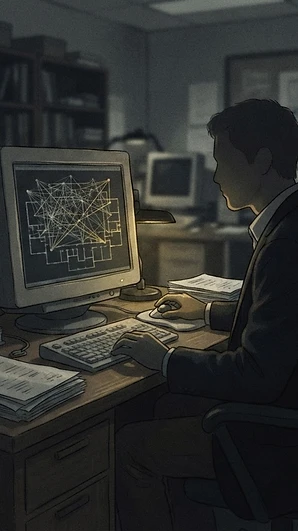

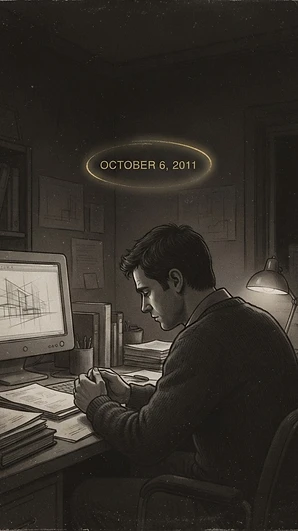
Alasdair Turner was a visionary British computer scientist who redefined how we analyze the built environment.
Alasdair Turner
d. 2011
60 Seconds: Alasdair Turner's Life Story
A look at the life and research of British computer scientist Alasdair Turner, a pioneer in urban modeling.
Transcript
Alasdair Turner was a visionary British computer scientist who redefined how we analyze the built environment. Born in London in 1969, he pursued his early studies at the University of Cambridge and the University of Edinburgh. He eventually joined University College London, becoming a key figure at the VR Centre for the Built Environment. Turner significantly advanced space syntax theory through his pioneering work on visibility graph analysis. He also authored the influential UCL Depthmap software, which became an essential tool for urban researchers worldwide. As a dedicated academic, he founded the MSc in Adaptive Architecture and Computation. In 2011, he was appointed a Reader in Urban and Architectural Computing. Alasdair Turner passed away from stomach cancer on October 6, 2011, leaving behind a profound legacy in computational design.
Play the illustrated life story above, or read the full biography on this page.
Visual credits: Generated illustration by The Deaths Archive (Generated illustration, not a photograph) · Own work (CC BY-SA 4.0) · Transferred from en.wikipedia to Commons. (CC BY-SA 3.0) · Generated illustration by The Deaths Archive (Generated illustration, not a photograph) · tommyvideo / Pixabay (Pixabay Content License) · Own work (CC BY-SA 3.0) · Generated illustration by The Deaths Archive (Generated illustration, not a photograph)
An illustrated presentation assembled inside the archive from the approved script and the credited images: narration, scene transitions and captions. Caption timing is estimated from the narration.
Narrated illustration. Images are sourced and credited; they are not presented as authenticated photographs.
Full Biography
|Patrick Alasdair Fionn Turner (19 October 1969 – 6 October 2011) was a British computer scientist and academic. He was a prominent figure at the VR Centre for the Built Environment and the Space Group at University College London (UCL). Turner's research significantly influenced the development of space syntax theory, particularly through his work on dynamic agent models and spatial analysis.
Education and early career
Turner was born on 19 October 1969 in London. He earned a Master of Arts in Natural Sciences from the University of Cambridge and a Master of Science in Artificial Intelligence from the University of Edinburgh. In 2011, he was appointed a Reader in Urban and Architectural Computing at University College London.
Research and contributions
Turner's research focused on the intersection of architecture, urban design, and the underlying computational systems of socio-physical environments. He developed models centered on the "structural coupling" between human agents and their background environment.
Agent-based modeling
Turner proposed that human movement patterns consist of two distinct types:
- Natural movement: A product of an agent's visual field and the spatial affordances of the built environment.
- Navigational movement: Learned patterns where agents retrieve spatial memory to reach specific destinations.
He implemented neural network methods to control agent behavior, aiming to create an "Ecomorphic" model where collective movement patterns and environmental formation share a reciprocal relationship. Working with Alan Penn, he introduced the concept of "exosomatic visual architecture," a paradigm where environmental configurations outside the body guide cognitive movement decisions.
Visibility graph analysis and Depthmap
Building upon the space syntax theory established by Bill Hillier and Julienne Hanson, Turner introduced visibility graph analysis (VGA) alongside Alan Penn, David O'Sullivan, and Maria Doxa. VGA represents space as intervisibility relationships within a grid, allowing for more granular analysis than traditional axial lines.
Turner authored the UCL Depthmap software, an open-source platform that integrated space syntax methods with his agent-based models. Depthmap became a primary tool for researchers in the field of urban morphology.
Teaching and art
Turner was the founder of the MSc in Adaptive Architecture and Computation at the Bartlett School of Architecture, UCL. He was an early adopter of the Processing programming language for architectural and creative design. His interests often overlapped with generative art and code explorations.
Death
Turner died on 6 October 2011 following a long struggle with stomach cancer.
Content from Wikipedia — licensed under CC BY-SA 3.0
Interactive
Test Your Knowledge – Trivia Challenge
How well do you know this person's life and legacy?
No account needed to play. Sign in to keep your score on the leaderboard.
Books & Media
Find books, audiobooks and films about Alasdair Turner on Amazon.

As an Amazon Associate I earn from qualifying purchases.
Amazon and the Amazon logo are trademarks of Amazon.com, Inc. or its affiliates.
Sources
- Wikipedia
- https://en.wikipedia.org/wiki/Alasdair_Turner
- CC BY-SA 4.0
- Sep 26, 2026
- View article
- Sep 26, 2026
Explore the archive
People who died on October 6

Spotted an error?
Help us keep the archive accurate. Report a correction with a source.
Report an error for Alasdair Turner →Advertisement
