
Photo: Vshaiva — CC BY-SA 3.0Source
Amarnath Vidyalankar
politician · social activist · journalist
- December 8, 1901 · Bhera
- September 21, 1985 · New Delhi
- 82 years


About Amarnath Vidyalankar
Amarnath Vidyalankar, 82, Indian politician, MP (1952–1967, 1971–1977).
Explore other notable deaths in 1985 or deaths in September 1985.
The Deaths Archive presents
How well do you know Amarnath Vidyalankar?
Explore their life. Test your knowledge. Beat the challenge.
10 questions · One legacy · How much do you really know?
Challenge your friends
Play together in real-time.
Advertisement

60 Seconds Life Story
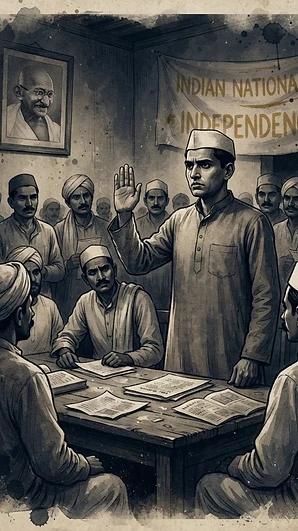


Amarnath Vidyalankar was a dedicated Indian politician, journalist, and social activist who played a
Amarnath Vidyalankar
1901 – 1985
60 Seconds: Amarnath Vidyalankar's Life Story
A brief overview of the life and political career of Indian politician and journalist Amarnath Vidyalankar.
Transcript
Amarnath Vidyalankar was a dedicated Indian politician, journalist, and social activist who played a significant role in his country's mid-twentieth century political landscape. Born in Bhera in 1902, he became deeply involved in the Indian independence movement and joined the Indian National Congress. His early career included teaching history in Lahore and serving as the personal secretary to Lala Lajpat Rai. Following India's independence, Vidyalankar served as the Minister of Education, Labor, and Languages for the State of Punjab from 1957 until 1962. He was a committed parliamentarian, serving three separate terms in the Lok Sabha between 1952 and 1977. Beyond his legislative service, he authored several books and remained an active member of the Indian National Congress until he died in New Delhi in 1985 at age eighty-two.
Play the illustrated life story above, or read the full biography on this page.
Visual credits: Vshaiva (CC BY-SA 3.0) · Generated illustration by The Deaths Archive (Generated illustration, not a photograph) · Own work (CC BY-SA 4.0) · Own work (CC BY-SA 4.0) · Flickr (Public domain) · stefaniejockschat / Pixabay (Pixabay Content License)
An illustrated presentation assembled inside the archive from the approved script and the credited images: narration, scene transitions and captions. Caption timing is estimated from the narration.
Narrated illustration. Images are sourced and credited; they are not presented as authenticated photographs.
Full Biography
|Amarnath Vidyalankar (8 December 1902 – 21 September 1985) was an Indian politician, social worker and journalist. He was involved in the independence movement and became a member of the Indian National Congress before India's independence in 1947. After independence, Vidyalankar served as Minister of Education, Labor and Languages in the Government of Punjab from 1957 to 1962 and was a member of the First (1952–1956), Third (1962–1967) and Fifth (1971–1977) Lok Sabhas.
Early life
Vidylankar was born in Bhera, Shahpur District (now Sargodha District), in pre-partition India on 8 December 1902. He was the son of Aruri Mal.
Vidyalankar was educated at Gurukul Kangri Vishwavidyalaya.
Political career
After Vidyalankar completed his education, he plunged himself into the non-cooperation movement.
Vidyalankar served as personal secretary of Lala Lajpat Rai from December 1926 until his death. He worked among Harijans through Achhut Uddhar Mandal and Harijans Seva Sangh between 1933 and 1940. He was also a life member of Servants of the Peoples Society where he organized kissan schools and study circles.
Lala Lajpat Rai gave Vidyalankar the job of teaching history at Lahore National College, where Bhagat singh and his associates were his students. After the closure of National College, Lala Lajpat Rai sent him to Hisar to assist famine victims in remote areas. In Haryana he worked in the labour movement, and in 1931 was sentenced to two years in jail for his editorial on the failure of the Round Table Conferences. He was also imprisoned for 2 years during Quit India movement. During the communal clashes in 1947, he organized rescue squads for people.
Vidyalankar was appointed by Rajendra Prasad (later the first President of India) as permanent secretary in the All India Congress Committee (AICC) office in Delhi. After a little more than a year, Vallabhbhai Patel asked him to run for the Punjab Assembly. Winning the seat by a large margin, Vidyalankar resigned as AICC permanent secretary.[additional citation(s) needed]
He served as president of the Punjab branch of the Indian National Trade Union Congress, leader of the Indian delegation to International Labour Organisation, leader of goodwill delegation to Yugoslavia, Afghanistan. He was also the director of National Mineral Development Corporation.
In 1951 he stood in the first Indian parliamentary election as the Indian National Congress candidate from Jullundur against Shiromani Akali Dal candidate Ajit Singh Sarhaddi, winning by a wide margin. In 1956 Vidyalankar won the Punjab Legislative Assembly from Jagadhri, and was asked to serve as a minister. From 1957 to 1962, he was Minister of Education, Labor and Languages and Health for the State of Punjab under Chief Minister Pratap Singh Kairon.[additional citation(s) needed]
He was a proponent of socialism and opined that that Congress must be turned into a cadre-based party in order to achieve socialism.
In 1962, he won the parliamentary election from Hoshiarpur.
In 1971, Vidyalankar stood for parliament from Chandigarh and was elected for a third time. During this period,[when?] he chaired three parliamentary committees appointed by the government: committees to study and improve the Information and Broadcasting Department and the Department of Supply and Disposal and a committee to study the national library in Calcutta. Vidyalankar was a member of the Public Accounts Committee, the Estimates Committee and the Committee on Public Undertakings.[additional citation(s) needed]
He was a member of AICC Bangladesh committee set up in 1971 to maximize the relief efforts for the refugees from Bangladesh.
On 23 July 1975, he voted in support of the proclamation of emergency in India.
In 1977, he decided not to continue in the legislature. Vidyalankar was active in the Indian National Congress until his death in 1985. [citation needed]
Writings
During his imprisonment during the 1930s and 1940s, Vidyalankar led worker study circles on political, social and economic subjects. He believed that workers should develop an Indian national feeling, regarding every Indian (regardless of caste, creed, language or ethnicity) as a brother. While he was in jail, he wrote four books in Hindi (Aaj Ki Duniya, Aaj Ka Manav Sansar, Bharat Ka Naya Itihas and Manav Sangharsh) and one in English (Evolution and Progress of the Human Race). Vidyalankar later wrote National Integration and the Teaching of History.
Content from Wikipedia — licensed under CC BY-SA 3.0
Interactive
Test Your Knowledge – Trivia Challenge
How well do you know this person's life and legacy?
No account needed to play. Sign in to keep your score on the leaderboard.
Videos about Amarnath Vidyalankar
Amarnath Vidyalankar
Embedded from YouTube; the archive does not host these recordings.
Books & Media
Find books, audiobooks and films about Amarnath Vidyalankar on Amazon.



As an Amazon Associate I earn from qualifying purchases.
Amazon and the Amazon logo are trademarks of Amazon.com, Inc. or its affiliates.
Sources
- Wikipedia
- https://en.wikipedia.org/wiki/Amarnath_Vidyalankar
- CC BY-SA 4.0
- Sep 26, 2026
- View article
- View record
- October 22, 2026
- Sep 26, 2026
Trivia & Knowledge· 16 questions
Questions drawn from Amarnath Vidyalankar's archived record and the sources above.
1.When Amarnath Vidyalankar taught at Lahore National College, who was one of his students?
- A.Rajendra Prasad
- B.Vallabhbhai Patel
- C.Lala Lajpat Rai
- D.Bhagat Singhcorrect
Amarnath Vidyalankar taught history at Lahore National College, where Bhagat Singh and his associates were his students.
Source: Political career section
2.What action did Amarnath Vidyalankar take on 23 July 1975?
- A.He was elected to the Fifth Lok Sabha.
- B.He became a member of the AICC Bangladesh committee.
- C.He voted in support of the proclamation of emergency in India.correct
- D.He resigned from the Indian National Congress.
On 23 July 1975, Amarnath Vidyalankar voted in support of the proclamation of emergency in India.
Source: Political career section
3.Amarnath Vidyalankar died in which year?
- A.1985correct
- B.1956
- C.1962
- D.1977
Amarnath Vidyalankar passed away on 21 September 1985.
Source: Introduction
4.Which of these books did Amarnath Vidyalankar write in English?
- A.Aaj Ka Manav Sansar
- B.Evolution and Progress of the Human Racecorrect
- C.Bharat Ka Naya Itihas
- D.Aaj Ki Duniya
Amarnath Vidyalankar wrote one book in English titled Evolution and Progress of the Human Race.
Source: Writings section
5.In 1951, Amarnath Vidyalankar won his parliamentary seat against which candidate?
- A.Bhagat Singh
- B.Ajit Singh Sarhaddicorrect
- C.Pratap Singh Kairon
- D.Vallabhbhai Patel
In 1951, Amarnath Vidyalankar won the parliamentary election from Jullundur against Shiromani Akali Dal candidate Ajit Singh Sarhaddi.
Source: Political career section
6.Amarnath Vidyalankar was a director for which organization?
- A.Achhut Uddhar Mandal
- B.Servants of the Peoples Society
- C.National Mineral Development Corporationcorrect
- D.International Labour Organisation
Amarnath Vidyalankar served as the director of the National Mineral Development Corporation.
Source: Political career section
7.Amarnath Vidyalankar served as the Minister of Education, Labor and Languages for which Indian state?
- A.Delhi
- B.Haryana
- C.Punjabcorrect
- D.West Bengal
From 1957 to 1962, Amarnath Vidyalankar served as Minister of Education, Labor and Languages for the State of Punjab.
Source: Introduction
8.Who appointed Amarnath Vidyalankar as permanent secretary in the AICC office in Delhi?
- A.Pratap Singh Kairon
- B.Rajendra Prasadcorrect
- C.Lala Lajpat Rai
- D.Vallabhbhai Patel
Rajendra Prasad, who later became the first President of India, appointed Amarnath Vidyalankar as permanent secretary in the AICC.
Source: Political career section
9.Amarnath Vidyalankar served as a member of the Lok Sabha during which of the following periods?
- A.1952–1956correct
- B.1933–1940
- C.1947–1950
- D.1980–1985
Amarnath Vidyalankar was a member of the First Lok Sabha from 1952 to 1956.
Source: Introduction
10.Which political party was Amarnath Vidyalankar a member of before India's independence in 1947?
- A.Shiromani Akali Dal
- B.Socialist Party of India
- C.Indian National Congresscorrect
- D.Communist Party of India
Amarnath Vidyalankar became a member of the Indian National Congress before India's independence in 1947.
Source: Introduction
11.Which of the following books did Amarnath Vidyalankar write in Hindi?
- A.National Integration and the Teaching of History
- B.Evolution and Progress of the Human Race
- C.The History of the Indian National Congress
- D.Manav Sangharshcorrect
Amarnath Vidyalankar wrote four books in Hindi, including Manav Sangharsh, while in jail.
Source: Writings section
12.In 1931, Amarnath Vidyalankar was sentenced to two years in jail for what reason?
- A.Participating in the Quit India movement
- B.Writing an editorial on the failure of the Round Table Conferencescorrect
- C.Teaching history at Lahore National College
- D.Organizing rescue squads for people during communal clashes
In 1931, Amarnath Vidyalankar was sentenced to two years in jail for his editorial on the failure of the Round Table Conferences.
Source: Political career section
13.Whose personal secretary did Amarnath Vidyalankar serve as starting in 1926?
- A.Rajendra Prasad
- B.Lala Lajpat Raicorrect
- C.Bhagat Singh
- D.Vallabhbhai Patel
Amarnath Vidyalankar served as the personal secretary of Lala Lajpat Rai from December 1926 until his death.
Source: Political career section
14.Where did Amarnath Vidyalankar receive his formal education?
- A.Gurukul Kangri Vishwavidyalayacorrect
- B.Calcutta National Institute
- C.University of Delhi
- D.Lahore National College
Amarnath Vidyalankar was educated at Gurukul Kangri Vishwavidyalaya.
Source: Early life section
15.What was the name of Amarnath Vidyalankar's father?
- A.Lala Lajpat Rai
- B.Pratap Singh Kairon
- C.Rajendra Prasad
- D.Aruri Malcorrect
The biography explicitly identifies Aruri Mal as the father of Amarnath Vidyalankar.
Source: Early life section
16.On what date was Amarnath Vidyalankar born?
- A.12 December 1905
- B.21 September 1985
- C.8 December 1902correct
- D.15 August 1947
Amarnath Vidyalankar was born on 8 December 1902 in Bhera, Shahpur District.
Source: Early life section
Explore the archive
People who died on September 21

Related People


Spotted an error?
Help us keep the archive accurate. Report a correction with a source.
Report an error for Amarnath Vidyalankar →Advertisement
