Burton Raffel
- September 29, 2015
- 87 years




About Burton Raffel
Burton Raffel, 87, American literary translator and writer.
Explore other notable deaths in 2015 or deaths in September 2015.
The Deaths Archive presents
How well do you know Burton Raffel?
Explore their life. Test your knowledge. Beat the challenge.
10 questions · One legacy · How much do you really know?
Challenge your friends
Play together in real-time.
Advertisement

Full Biography
|Burton Nathan Raffel (April 27, 1928 – September 29, 2015) was an American writer, translator, poet and professor. He is best known for his vigorous translation of Beowulf, still widely used in universities, colleges and high schools. Other important translations include Miguel de Cervantes' Don Quixote, Poems and Prose from the Old English, The Voice of the Night: Complete Poetry and Prose of Chairil Anwar, The Essential Horace, Rabelais' Gargantua and Pantagruel and Dante's The Divine Comedy.
Biography
Raffel was born in New York City in 1928. An alumnus of James Madison High School in Brooklyn, New York (1944), Raffel was educated at Brooklyn College (B.A., 1948), Ohio State University (M.A., 1949), and Yale Law School (J.D., 1958). As a Ford Foundation fellow, Raffel taught English in Makassar, Indonesia, from 1953 to 1955. Following the completion of his legal studies and admission to the New York State Bar in 1959, Raffel practiced law as an associate at Milbank, Tweed, Hadley & McCloy before deciding that he was not suited to practice law. Between 1960 and 1963, he served as founding editor of Foundation News, a trade journal published by the Council on Foundations.
He taught at Brooklyn College (lecturer in English, 1950–51), Stony Brook University (instructor of English, 1964–65; assistant professor of English, 1965–66), the University at Buffalo (associate professor of English, 1966–68), the University of Haifa (visiting professor of English, 1968–69), the University of Texas at Austin (visiting professor of English, 1969–70; professor of English and classics and chair of the graduate program in comparative literature, 1970–71), the Ontario College of Art (senior tutor, 1971–72), York University, Toronto (visiting professor of humanities, 1972–75), Emory University (visiting professor, spring 1974) and the University of Denver (professor of English, 1975–89).
From 1989 until his death, he held the chair in Humanities at the University of Louisiana at Lafayette, ultimately retiring from active service as distinguished professor emeritus of arts and humanities and professor emeritus of English in 2003.
Raffel died on September 29, 2015, at the age of 87.
Translations
He translated many poems, including the Anglo-Saxon epic Beowulf, poems by Horace, and Gargantua and Pantagruel by François Rabelais. In 1964, Raffel recorded an album along with Robert P. Creed, on Folkways Records entitled Lyrics from the Old English. In 1996, he published his translation of Miguel de Cervantes' Don Quixote, which has been acclaimed for making Cervantes more accessible to the modern generation. In 2006, Yale University Press published his new translation of the Nibelungenlied. Among his many edited and translated publications are Poems and Prose from the Old English, and Chrétien de Troyes' Cligès, Lancelot, the Knight of the Cart, Perceval, the Story of the Grail, Erec and Enide, and Yvain, the Knight of the Lion.
Raffel worked with Yale University Press and Harold Bloom on a series of 14 annotated Shakespeare plays. In 2008 the Modern Library published his new translation of Geoffrey Chaucer's The Canterbury Tales.
Raffel's main contribution to translation theory was the principle of "syntactic tracking", which he championed in a monograph published in 1994. According to this theory, a good translation of a prose literary text should track the syntax of the original element-by-element, never joining sentences where the original separated them, never splitting a long sentence, never rearranging the order of ideas. The accuracy of tracking is measured syntactically by counting punctuation marks: the best translation will be the one which comes closest to the original in a statistical analysis of commas, colons and full stops. Raffel claimed that those translators who heed the syntax also make the best lexical choices, so that tracking becomes a measure not only of syntactic accuracy but of translating skills per se. This principle has since been applied in scholarly studies of translations of classical and modern works.
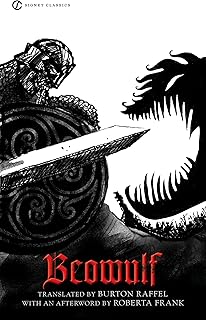
Beowulf translation
Raffel's 1963 Beowulf has been described by Hugh Magennis as "an extremely free imitative verse." Magennis calls it highly accessible and readable, using alliteration lightly, and creating a "vivid and exciting narrative concerned with heroic exploits ... in a way that [the modern reader] can understand and appreciate. Clarity, logic and progression are hallmarks of this treatment of narrative in Raffel's translation, producing a satisfying impression of narrative connectedness".
Literary production
Over the years he published numerous volumes of poetry; however, only one remains in print: Beethoven in Denver. Beethoven describes what happens when the dead composer visits Denver, Colorado, in the late 1970s. Also set in Colorado was the Raffel-scripted film, The Legend of Alfred Packer, the first film version of the story of Alfred Packer.
Content from Wikipedia — licensed under CC BY-SA 3.0
Interactive
Test Your Knowledge – Trivia Challenge
How well do you know this person's life and legacy?
No account needed to play. Sign in to keep your score on the leaderboard.
Books & Media
Find books, audiobooks and films about Burton Raffel on Amazon.



As an Amazon Associate I earn from qualifying purchases.
Amazon and the Amazon logo are trademarks of Amazon.com, Inc. or its affiliates.
Sources
- Wikipedia
- https://en.wikipedia.org/wiki/Burton_Raffel
- CC BY-SA 4.0
- Sep 26, 2026
- View article
- Sep 26, 2026
People who died on September 29
Spotted an error?
Help us keep the archive accurate. Report a correction with a source.
Report an error for Burton Raffel →Advertisement
