Rainer Barzel
- August 26, 2006
- 82 years


About Rainer Barzel
Rainer Barzel, 82, German President of the Bundestag, Chairman of the Christian Democratic Union.
Explore other notable deaths in 2006 or deaths in August 2006.
The Deaths Archive presents
How well do you know Rainer Barzel?
Explore their life. Test your knowledge. Beat the challenge.
10 questions · One legacy · How much do you really know?
Challenge your friends
Play together in real-time.
Advertisement
60 Seconds Life Story


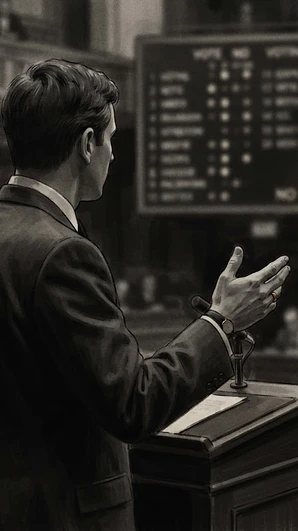


Rainer Barzel was a central figure in West German politics, serving as chairman of the CDU and president of
Rainer Barzel
d. 2006
60 Seconds: Rainer Barzel's Life Story
A profile of Rainer Barzel, the former Bundestag President and CDU chairman who shaped West German politics.
Transcript
Rainer Barzel was a central figure in West German politics, serving as chairman of the CDU and president of the Bundestag. Born in East Prussia, he rose through the party ranks to become a powerful parliamentary leader during the 1960s. In 1972, he led the first constructive vote of no confidence against Chancellor Willy Brandt, failing by only two votes. This dramatic political maneuver aimed to challenge the government's Eastern Policy. Following his resignation as party chairman in 1973, he later returned to serve as president of the Bundestag from 1983 to 1984. He retired from political life shortly after, following his involvement in the Flick affair. Rainer Barzel died in Munich in 2006 at the age of 82.
Play the illustrated life story above, or read the full biography on this page.
Visual credits: This file was provided to Wikimedia Commons by the Konrad-Adenauer-Stiftung, a German political foundation, as part of a cooperation project. (CC BY-SA 3.0 de) · Invaluable (Public domain) · Generated illustration by The Deaths Archive (Generated illustration, not a photograph) · Ball State University (Public domain) · Own work (CC BY-SA 3.0) · Photographic reproduction of the original newspaper (Public domain) · Own work (CC BY-SA 4.0)
An illustrated presentation assembled inside the archive from the approved script and the credited images: narration, scene transitions and captions. Caption timing is estimated from the narration.
Narrated illustration. Images are sourced and credited; they are not presented as authenticated photographs.
Full Biography
|Rainer Candidus Barzel (20 June 1924 – 26 August 2006) was a German politician of the Christian Democratic Union (CDU). He served as the eighth president of the Bundestag from 1983 to 1984.
Barzel had been the leader of his parliamentary group and a short time federal minister, before his party went into opposition in 1969. Subsequently, Barzel became chairman of the party. He tried to become federal chancellor via a constructive vote of no confidence in 1972, leading the first such attempt in the Federal Republic. He unexpectedly came two votes short. In the subsequent general elections of November 1972, he was the unsuccessful main candidate of the CDU/CSU. He lost his chairmanship the year after but remained an influential member of the parliament.
Biography
Born in Braunsberg, East Prussia (present-day Braniewo, Poland), Barzel served as Chairman of the CDU from 1971 to 1973 and ran as the CDU's candidate for Chancellor of Germany in the 1972 federal elections, losing to Willy Brandt's SPD.
Barzel served as Minister of All-German Affairs (1962–63) under Konrad Adenauer, as Parliamentary group leader of the CDU/CSU (1964–1973), as Minister of Intra-German Relations (1982–1983) in Helmut Kohl's cabinet, and as President of the Bundestag (1983–1984).
The 1972 election is commonly regarded as an indirect referendum on Chancellor Brandt's Ostpolitik (Eastern Policy), which called for normalized relations with East Germany and the Soviet Union, which Barzel vehemently opposed. On 27 April 1972 Barzel and the CDU/CSU tabled a constructive vote of no confidence against Brandt's government. Due to several SPD and FDP members switching to the CDU and a number of FDP members withdrawing support for the coalition, on paper the CDU had just enough support to oust Brandt and make Barzel Chancellor of Germany.
The implications of this vote were far-reaching. Brandt's initial reaction was that he, along with his policy of Ostpolitik, was finished. Several German trade unions went on strike in anticipation of his loss in the no-confidence motion. However, in the final tally, the motion received 247 votes, two short of the 249 needed to expel Brandt from office. Persuasive evidence subsequently emerged that two members of Barzel's caucus, Julius Steiner (CDU) and Leo Wagner (CSU) had been bribed by the East German Ministry for State Security. Details of the alleged East German involvement remain hazy, however: not all commentators are persuaded that East German bribes were the most decisive factor in the tantalisingly narrow failure of the no-confidence vote.
The government, in consideration of the fact that it had lost its effective parliamentary majority and that parliamentary work was stalled, reacted by deliberately losing a vote of confidence, which then allowed President Gustav Heinemann to dissolve the Bundestag and call early elections, which Brandt and the SPD handily won. 1972 was the only time between the war and German reunification that saw the SPD place first in a federal German election, and it still represents the SPD's high-water mark in vote share. That year's elections had the highest turnout of any German federal election at 91.1%, one of the highest turnouts ever recorded in national elections without mandatory voting.
Within the CDU group of the German parliament, Barzel's credibility suffered when it became apparent that he had lied about substantial outside income from work as a lawyer outside parliament.
It was neither the lost no-confidence motion nor the lost parliamentary elections that, on 8 May 1973, eventually prompted Barzel to resign from both the CDU party chair and the leadership of the CDU/CSU parliamentary group. It was the refusal by the parliamentary group to support a government bill for the accession of both German states to the United Nations. He was the first leader of the CDU who stood down without ever becoming Chancellor.
In 1982, Barzel married the political scientist Helga Henselder-Barzel.
Barzel retired from political life in 1984 after he was accused of being entangled in the Flick affair, a charge rejected by the Flick inquiry committee and the prosecuting authorities two years later.
Barzel died in Munich, Bavaria, after a long illness, on 26 August 2006, aged 82.
Publications
- Gesichtspunkte eines Deutschen. Düsseldorf, Econ 1968
- Unterwegs – Woher und wohin? München, Droemer Knaur 1982
- Im Streit und umstritten. Anmerkungen zu Konrad Adenauer, Ludwig Erhard und den Ostverträgen. Berlin, Ullstein 1986
- Geschichten aus der Politik. Persönliches aus meinem Archiv. Berlin, Ullstein 1987
- Die Tür blieb offen – Ostverträge-Misstrauensvotum-Kanzlersturz. Bonn, Bouvier 1998, ISBN 3-416-02836-8
- Ein gewagtes Leben. Stuttgart, Hohenheim 2001, ISBN 3-89850-041-1
Content from Wikipedia — licensed under CC BY-SA 3.0
Interactive
Test Your Knowledge – Trivia Challenge
How well do you know this person's life and legacy?
No account needed to play. Sign in to keep your score on the leaderboard.
Books & Media
Find books, audiobooks and films about Rainer Barzel on Amazon.



As an Amazon Associate I earn from qualifying purchases.
Amazon and the Amazon logo are trademarks of Amazon.com, Inc. or its affiliates.
Sources
- Wikipedia
- https://en.wikipedia.org/wiki/Rainer_Barzel
- CC BY-SA 4.0
- Sep 26, 2026
- View article
- Sep 26, 2026
People who died on August 26
Spotted an error?
Help us keep the archive accurate. Report a correction with a source.
Report an error for Rainer Barzel →Advertisement